%20(1).svg)

IT teams support more employees every year without more people to do it. As that ratio stretches, ticket volume outpaces the team, and the issues that actually matter wait behind password resets and access requests.
AI IT help desk software targets that layer by using conversational AI to resolve Tier-1 tickets automatically. This becomes even more essential due to SaaS sprawl, where there is no or limited oversight of new tools being adopted.
This means that IT teams need to handle access approvals across hundreds of applications, alongside constant onboarding, role changes, and departures.
Below, we compare the leading AI IT help desk tools on what they resolve, which tools they integrate with, pricing, and where each falls short.
TL;DR
Top 8 AI IT helpdesk software for teams that need to auto-resolve more tickets and free up support technicians
Here's how the eight leading AI IT support tools compare on best fit, starting price, and standout features. The differences that matter are whether the AI resolves a request or routes it, and whether you keep your existing ticketing system.
1. Moveworks: Best for large enterprises working with ServiceNow

Moveworks, acquired by ServiceNow, is an enterprise AI assistant platform that answers questions and completes tasks across business systems, spanning IT, HR, finance, sales, and engineering.
Employees ask in Slack, Teams, or a portal, and the Moveworks Reasoning Engine plans and executes the request end to end.
Standout AI capabilities
- Reasons through a request end to end with the Reasoning Engine, which understands, plans, executes, and adapts until the task is complete.
- Searches for relevant knowledge across Slack, OneDrive, Google Drive, SharePoint, Confluence, Outlook, and 50+ other systems.
- Enables you to build custom AI agents in Agent Studio with low-code tooling. Or, install pre-built ones from a marketplace that lists 1,000+ agents.
- Serves employees in over 100 languages across chat, browser, intranet, portal, and mobile.
- Tracks adoption and resolution metrics and analyzes your support tickets in real time with Employee Experience Insights.
Key integrations
- Chat: Slack, Microsoft Teams, Google Chat, Zoom
- ITSM: ServiceNow, Jira, Freshservice, Zendesk
- Identity: Okta, OneLogin, Duo, SailPoint
- Knowledge: Confluence, SharePoint, Google Drive, Notion
Pricing model
Moveworks doesn’t publish any pricing information, so you’ll have to reach out to sales to get a quote.
Where it falls short: It’s built for the upper end of the market, so may not be suitable for smaller or growing companies that need a tool that provides value from day one.
Looking for alternatives? Read about the top Moveworks competitors.
2. Risotto: : IT teams who need employee requests resolved end to end inside Slack

Risotto automatically resolves Tier-1 requests that arrive via email, a ticket portal like Jira, or the chat tool your employees already use.
It sits on top of the ticketing system you already run, and syncs bi-directionally with Jira, Freshservice, and more, so your existing system stays the system of record.
If a request needs to be escalated, the IT team receives full context so they can jump right in and resolve the issue quicker.
Standout AI capabilities
- Resolves requests end to end, with multi-step troubleshooting and clarifying questions, plus real actions like granting access, resetting passwords, and writing back to the knowledge base.
- Automates access and identity requests in plain language, using role-based rules and approval chains to grant access only when it is needed. Temporary access can be revoked automatically after a set period, with every action recorded in an audit log.
- Builds automated workflows for complex requests in minutes with a no-code runbook builder, rather than a week of scripting.
- Learns from every resolved thread, feeding answers back into the knowledge base and letting teams turn a Slack resolution into a permanent article by reacting with a single emoji.
- Cites its sources on every answer, whether that’s Confluence, Notion, Drive, or a past Slack thread, and reads error screenshots so employees don’t have to describe the problem.
Key integrations
- Chat: Slack, Microsoft Teams
- Ticketing: Jira, Freshservice, Zendesk, ServiceNow, plus Risotto's native ticketing
- Knowledge: Confluence, Notion, Google Drive, Slack history
- Identity: Okta, Google Workspace, Microsoft Entra, Opal
Pricing model
Annual contracts, priced on employee headcount. There are two plan options:
- Startup Plan: $1,250/m (paid annually), available to <200 employees
- Enterprise: Custom pricing, for larger organizations
A 30-day free trial lets you test Risotto to see what it can do for your team before you commit.
Where it falls short: Internal employee support only. Teams looking to automate customer-facing support should look elsewhere.
Get an AI agent that auto-solves issues and free up time for your IT team. Learn more
3. Aisera: Best for support teams covering employees and customers on one platform
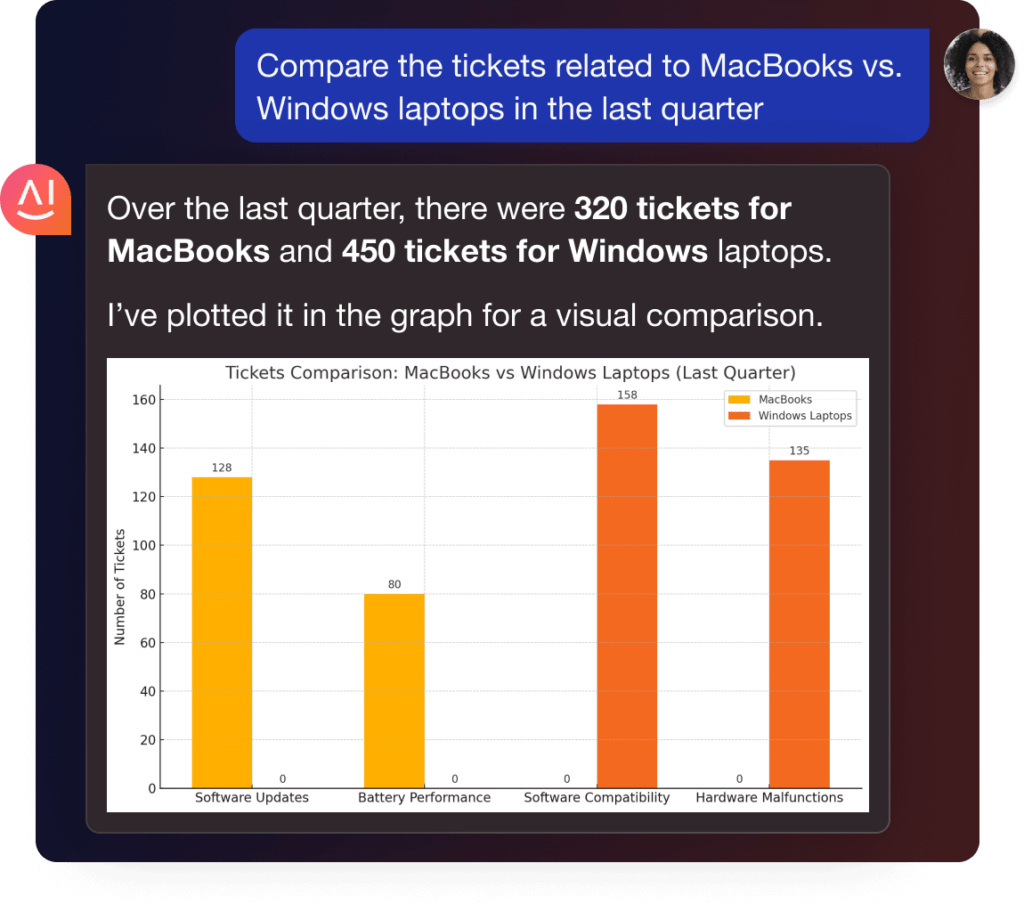
Acquired by Automation Now, Aisera is an enterprise agentic AI platform that automates work across IT, HR, finance, procurement, facilities, legal, and customer service.
Its AI agents answer questions and execute tasks through chat, portals, and Teams, with domain-tuned language models behind them.
Standout AI capabilities
- Executes complex, cross-domain actions through a system of AI agents orchestrated by Aisera Assistant and Agent Assist.
- Enables you to build custom agents in natural language with Agent Composer, or deploy existing agents from a library.
- Connects agents, apps, and tools through Aisera Unify, an open standards backbone built on A2A, MCP, and AGNTCY.
- Runs on Aisera's own LLM or an organization's own models, with tuning against internal knowledge and ITSM data.
- Generates knowledge and automation playbooks from past resolutions, end-user feedback, and expert input.
Key integrations
- Chat: Microsoft Teams, Slack, Google Chat, Zoom
- ITSM: ServiceNow, Jira, Freshservice, Zendesk
- Identity: Okta, Microsoft Entra, OneLogin, Ping Identity
- Knowledge: Confluence, SharePoint, Notion, Guru
Pricing model
Aisera doesn’t publish any pricing information, so you’ll have to reach out to sales to get a quote.
Where it falls short: The platform spans procurement, legal, retail, telecom, healthcare, and customer service, so an IT team gets a general-purpose platform rather than a tool shaped around its specific workflows.
4. Glean: Best for making scattered company knowledge searchable across every department
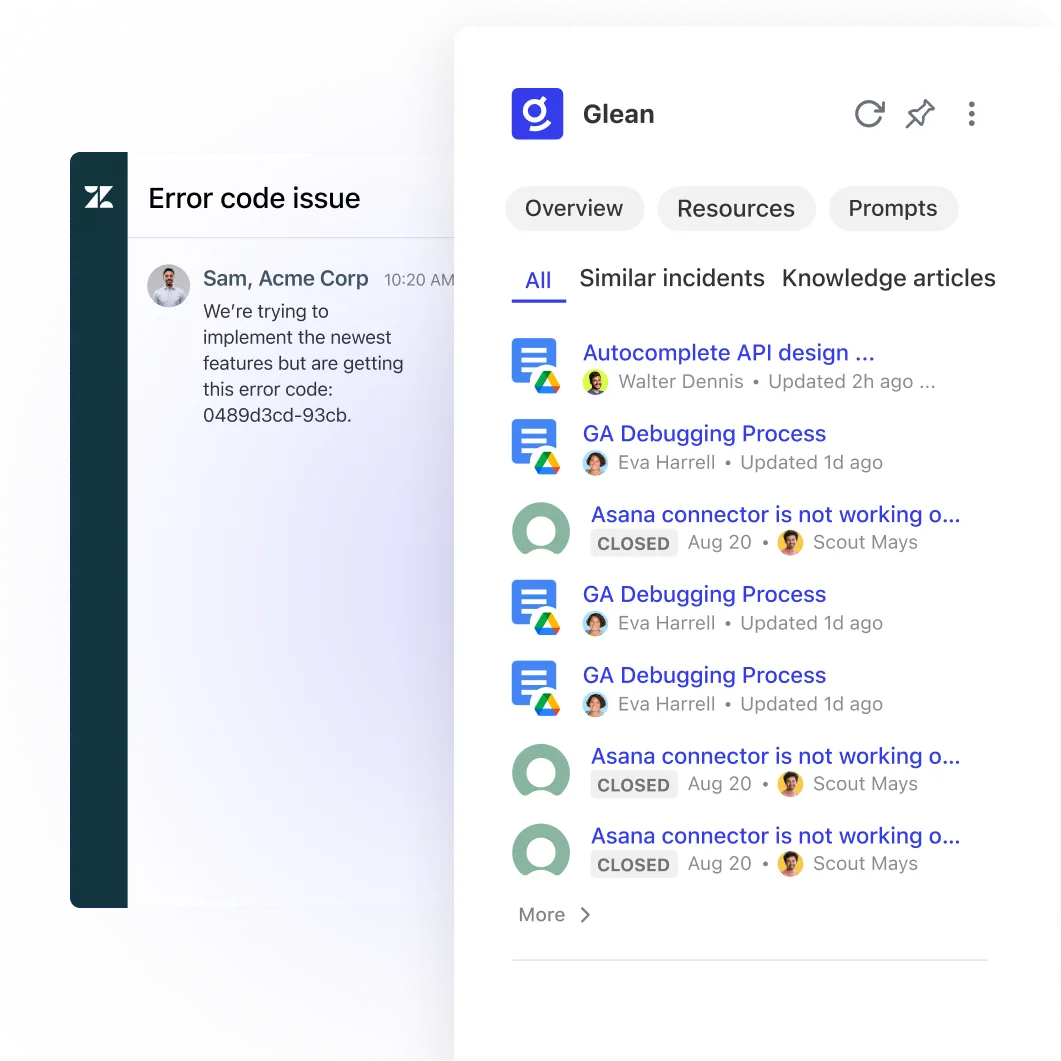
Glean is an enterprise search and AI platform that indexes company knowledge across connected apps, builds a graph of how the business works and lets teams build agents on top of that context.
It supports IT alongside departments such as engineering, sales, marketing, HR, finance and legal, giving organizations broad company-wide coverage rather than a help desk built specifically for IT.
Standout AI capabilities
- Answers questions from indexed company knowledge, with source permissions enforced and reflected in results as soon as they change.
- Enables you to build custom agents in Agent Builder, or deploy reusable ones from the Agent Library.
- Triggers agents on events or schedules and chains actions across systems, with human-in-the-loop approval before execution.
- Runs on 35 or more LLMs through Model Hub, so teams aren’t locked into one provider.
- Extends coverage through custom connectors, custom actions, and remote MCP servers when a native connector doesn’t exist.
Key integrations
- Chat: Slack, Microsoft Teams, Google Chat, Gmail
- ITSM: ServiceNow, Jira, Freshservice, Zendesk
- Identity: OneLogin, Okta, Stytch, Keycloak
- Knowledge: Confluence, SharePoint, Google Drive, and Box
Pricing model
Glean doesn’t publish any pricing information, so you’ll have to reach out to sales to get a quote.
Where it falls short: Glean focuses on ticket deflection or reduction through self-service tools rather than end-to-end resolution.
5. Freshservice: Best for IT teams that want ticketing, asset management, and operations in one place

Freshservice is Freshworks' ITSM platform, built on ITIL practices. It covers the whole service desk stack, from ticketing and change management to IT operations and enterprise service management for teams like HR and finance. Freddy AI runs across it as a copilot for agents, an agent builder, and an insights layer.
Standout AI capabilities
- Interprets conversational requests, matches them to the right service context, and resolves them end to end.
- Creates and updates tickets from Slack and Microsoft Teams through ServiceBot, which ships on every plan including Starter.
- Enables you to build custom AI agents in Freddy AI Agent Studio, without leaving the platform.
- Surfaces ticket trends through Freddy AI Insights, which gives you alerts on patterns without manual reporting.
- Connects outside AI agents and tools to Freshservice through MCP, with permission controls you configure.
Key integrations
- Chat: Slack, Microsoft Teams, Zoom
- ITSM: Freshservice is the system of record itself, with the Freshworks Marketplace connecting adjacent tools like GitHub and monday.com
- Identity: Okta, Microsoft Azure, Google Workspace
- Knowledge: Confluence, Notion, Box
Pricing model
There are four plans available for Freshervice for IT teams:
- Starter: $19/month/agent, billed annually
- Growth: $29/month/agent, billed annually
- Pro: $99/month/agent, billed annually
- Enterprise: Custom pricing, includes Freddy AI
Freddy AI Copilot costs an additional $29/month/agent on both the Pro and Enterprise plans. The Enterprise plan includes Freddy AI Agent (Classic) and Freddy AI Insights.
Asset management is metered separately through Asset Units, sold in packs of 500, and there's a 14-day free trial.
6. Leena AI: Best for large organizations automating multi-app tasks across IT, HR, and finance

Leena AI’s agentic AI platform for back-office employee support covers IT, HR, finance, procurement, and sales.
Its Autonomous Agent breaks a request into subtasks, hands each to an agent, and coordinates the run through a central orchestrator it calls the Leena AI Brain. The result is multi-app work from a single prompt rather than siloed answers.
Standout AI capabilities
- Breaks complex requests into subtasks and routes each to an application-specific agent, coordinated by WorkLMTM and a central orchestrator.
- Handles common IT work directly, including password resets, application access, email group changes, and system slowness.
- Retrieves answers through Agentic RAG, picking a retrieval path per query instead of running one fixed pipeline.
- Builds knowledge, workflows, and process automations through Knowledge Studio, Workflow Studio, and AOP Studio.
- Communicates with outside agents and tools through built-in A2A and MCP support.
Key integrations
- Chat: Microsoft Teams, Slack
- ITSM: ServiceNow, Jira, BMC Helix
- Identity: Okta, Azure, Active Directory
- Knowledge: Confluence, SharePoint, Box, Dropbox
Pricing model
Leena AI doesn’t publish any pricing information, so you’ll have to reach out to sales to get a quote.
Where it falls short: It treats IT as one of five functions. The platform spans IT, HR, finance, procurement, and sales, so you're buying a back-office program rather than a dedicated service desk tool.
7. Jira Service Management: Best for IT teams already running Jira and Confluence
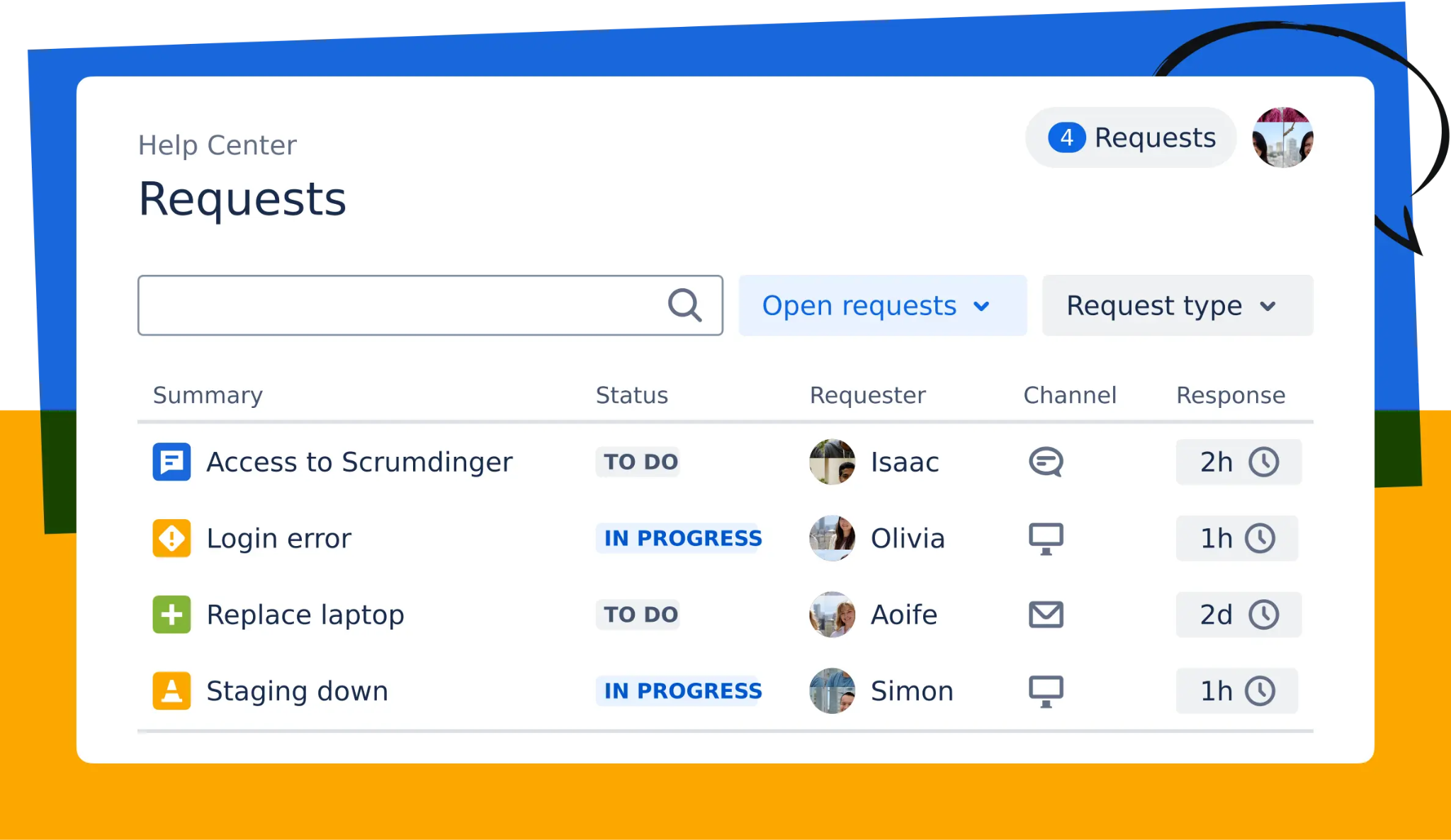
Jira Service Management (JSM) is Atlassian's ITSM product, now sold as part of the Service Collection. It handles request intake, incident, problem and change management, on-call alerting, and asset and configuration management, with a knowledge base powered by Confluence.
AI is tiered in two layers: Rovo search, chat, and agents from the Standard plan, and a virtual service agent from Premium.
Standout AI capabilities
- Answers employee requests conversationally through the Virtual Service Agent, by matching questions to intents and resolving them with Atlassian Intelligence answers.
- Searches Atlassian content and runs agents through Rovo, included from the Standard plan upward.
- Groups alerts, creates incidents, and generates post-incident reviews with AIOps on Premium.
- Assesses change risk with AI and routes approvals by change type or CAB procedure.
- Recommends relevant knowledge articles at the point of request, which Atlassian frames as deflecting requests through self-service.
Key integrations
- Chat: Slack, Microsoft Teams
- ITSM: JSM is the system of record itself, with the Atlassian Marketplace connecting thousands of third-party apps
- Identity: Atlassian Guard for SSO, SCIM, and Active Directory provisioning, sold as a separate subscription
- Knowledge: Confluence, embedded directly in the service desk
Pricing model
There are four plans available:
- Free for up to three agents
- Standard: From $20/month/agent
- Premium: From $51.42/month/agent
- Enterprise: Custom pricing, billed annually
Monthly pricing decreases as the number of agents grows. Annual billing can save up to 17%. Atlassian offers a 14-day free trial of its Standard and Premium plans, which can be extended to a maximum of 30 days on request.
Also note that usage beyond each plan’s included Assets allowance starts at $0.02 per object per month. Premium and Enterprise plans include 1,000 Virtual Service Agent-assisted conversations per month, or 12,000 per year with annual billing. Additional usage starts at $0.30 per assisted conversation.
Where it falls short: Meters the AI by conversation and counts conversations it doesn't resolve, meaning you pay whether the virtual agent resolves it or escalates to a human.
Add a powerful AI layer on top of JSM for end-to-end resolution Risotto sits on top of Jira, so you can keep your existing ticketing system while getting an autonomous, AI-powered Tier-1 responder. Learn more.
9. Zendesk: Best for teams that want a service desk they can buy and launch without developers

Zendesk sells a dedicated internal support product, Zendesk for Employee Service, alongside the customer support platform it's better known for.
It pulls request and incident management, knowledge, a service catalog, and asset management into one workspace, with AI agents that handle routine multi-step requests like password resets and access approvals.
Standout AI capabilities
- Completes routine multi-step employee requests with AI agents, from password resets to access approvals, following your existing workflows and policies.
- Assists your team through Copilot, which reads context, routes requests, recommends next steps, and takes action on its own.
- Surfaces knowledge in context for both employees and service teams, by drawing on connected external sources as well as its own help center.
- Reviews every employee service interaction with AI-powered QA, which flags SLA risks and policy gaps in real time.
- Runs on multiple LLMs, including OpenAI through zero data retention endpoints and models hosted on Azure, Bedrock, or Google Cloud.
Key integrations
- Chat: Slack, Microsoft Teams
- ITSM: Zendesk is the system of record itself, with 1,800+ Marketplace apps connected to third-party tools
- Identity: Okta, Active Directory
- Knowledge: Its own help center, plus connected external knowledge sources
Pricing model
There are four plans available for Zendesk for Employee Service:
- Suite Team: $29/month/agent, billed annually
- Suite Growth: $59/month/agent, billed annually
- Suite Professional: $99/month/agent, billed annually
- Suite Enterprise + Copilot: Custom pricing
Copilot is a $50/month/agent add-on, with Quality Assurance at $35/month/agent and Advanced Data Privacy and Protection at $50/month/agent. There's a 14-day trial on Suite Professional with Copilot included.
Where it falls short: Prices the AI assistant separately. Copilot costs $50 per agent each month on top of a plan starting at $29, which can more than double the per-seat cost of the entry tier.
How to determine which AI IT helpdesk software will work best for your team
When buying AI helpdesk software, there’s one question that should drive your decision: do we need the tool to resolve tickets end to end or just route and tag them? This is the difference between a solution that makes work easier and one that gets rid of tasks altogether.
So before you book a demo, pull your last quarter of tickets and sort them by category. Then price each shortlist candidate against that volume, because per agent, per conversation, and per asset meters produce very different bills.
If your queue is heavy on asset tracking and change management, look at an IT ticketing platform like Freshservice or Jira Service Management. But if password resets, access requests, and app questions dominate, adding an AI layer like Risotto that resolves Tier-1 in chat will move your numbers faster than a platform migration will.
One customer auto-resolves 55% of tickets with Risotto, while another sees 60% faster Tier-1 ticket resolution. So for lean IT teams, the math usually favors adding AI to the service desk you already run. Risotto resolves requests end to end inside Slack and Teams while Jira or Freshservice remains your system of record.

Liked the article? Share on:
On this page
Stop working the Tier-1 queue manually. Risotto resolves common requests inside Slack and Teams, no agent intervention needed.





Want faster solutions and happier employees?
Access that's easy to ask for and impossible to get wrong.
Ensure Legal never answers another "do we need an NDA for this?"
Every policy question is stealing time from the work Finance was hired to do.
Turn Slack requests into action items instead of engineering interruptions.
The biggest deal risk might be an unanswered internal question.
Run a united support system that your employees can depend on.
Build the automations you’ve been planning on for months.
The bottleneck isn't your team. It's the groundwork before they can actually help.
Get support data that your team can talk to.
Jump on a call to understand:
Risotto handles repetitive support requests across tools and teams, so IT gets back to solving real problems, not rerunning the same ones.
.svg)
%20(1).webp)
See what makes the Iru integration a 10/10 for our clients.